
Why the new circular economy strategy also concerns agriculture
On 3 June 2026, the German Federal Cabinet adopted an action programme to implement the National Circular Economy Strategy [1] Its aim is to conserve resources, protect the environment and make Germany less dependent on raw material imports. The programme includes, among other things, a platform for relevant stakeholders, investment and innovation funding, digital product passports, AI applications for circular economy and resource efficiency, and the further development of the legal framework.
This is an important step. In times of uncertain supply chains, rising raw material prices and growing geopolitical dependencies, circular economy is not only environmental policy. It is also industrial policy, raw material policy and innovation policy.
Yet when people talk about circular economy, many first think of recycling centres, metals, plastics, batteries or building materials. This is understandable, because technical material cycles are central to industry, infrastructure and resource security.
But circular economy does not begin with recycling. It begins with the question of how materials move through production systems in the first place — and whether they end up as waste or become the basis for the next process.
What does the Circular Economy Strategy say?
The National Circular Economy Strategy does not understand circular economy solely as an environmental programme, but also as a contribution to raw material security, stronger supply chains, competitiveness and the resilience of Germany as a business location.
The aim is to reduce the consumption of primary raw materials, close material cycles and keep materials in the economic system for as long as possible.
To achieve this, the strategy relies on several levers: investment and innovation funding, digital product passports, circular industrial data spaces, AI applications, stronger public procurement of circular products and the further development of the legal framework. Another important component is the planned Circular Economy Platform. This platform is intended to bring together the federal government, the federal states and municipalities, business, civil society, culture and science on a regular basis in order to support and further develop the implementation of the strategy.
For the time being, the programme primarily addresses technical cycles. Materials are to be used for longer, reused, repaired, recycled or recovered as secondary raw materials. This is important and correct.
At the same time, the legal definition in the German Circular Economy Act already shows how strongly the term has so far been shaped by waste legislation. Section 3 paragraph 19 states: “Circular economy within the meaning of this Act means the prevention and recovery of waste.” For a comprehensive circular economy, however, this perspective is not enough. Biological cycles do not begin with waste. They begin where nutrients, water, energy and biomass are guided through a production system.
Nature knows no waste
In natural ecosystems, there is no waste in the true sense. What is a residual substance for one organism becomes a resource for the next. Plants, animals, fungi, microorganisms and bacteria do not form linear production chains, but metabolic relationships.
Leaves fall and decompose. Microorganisms make nutrients available. Plants take up these nutrients again. Animals eat plants or other animals. Excretions, dead biomass and organic residues become part of the system once more. From this perspective, circular economy is not a new principle. It is a basic pattern of life.
Modern industry is now trying to redesign technical systems according to this principle. Products should no longer be disposed of after single use, but kept within material cycles. In agriculture, however, this principle is much closer at hand. Agriculture has always worked with biological resource flows: water, nutrients, biomass, feed, manure, soil life, plant growth and animal production.
That is why agriculture is predestined for circular economy.
Where circular economy was originally at home
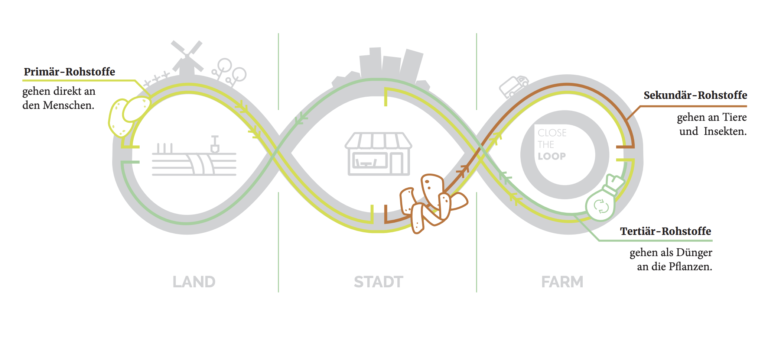
Historically, agricultural farms were more closely embedded in local cycles. Plant residues, manure, compost, feed, bedding and soil fertility were directly connected. A farm was never a completely closed system, but many material flows remained within the farm or the region.
With specialisation, intensification and globalised supply chains, many of these relationships have been dissolved or outsourced. Feed comes from outside. Fertiliser is produced industrially or transported over long distances. Animal husbandry, crop production, energy production and nutrient management are often separated from one another.
This creates high productivity, but also new dependencies and losses.
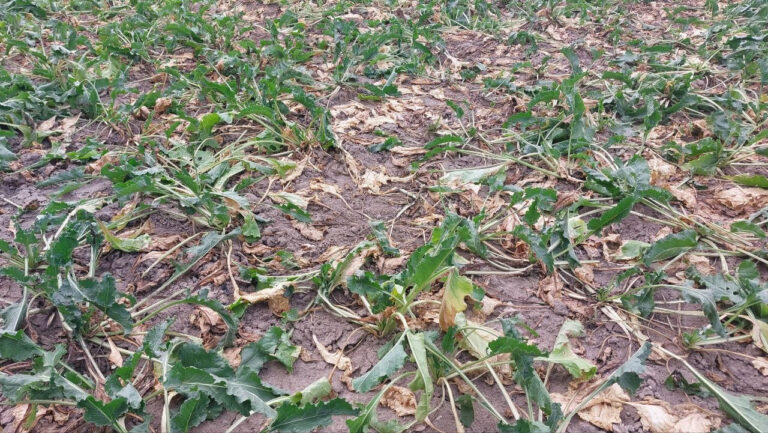
In open-field cultivation, nutrient losses can never be completely avoided. Rain, soil structure, weather, leaching and biological processes mean that material flows cannot be fully controlled. This is not the fault of individual farms. It is a property of open systems.
Aquaponics makes nutrient flows visible
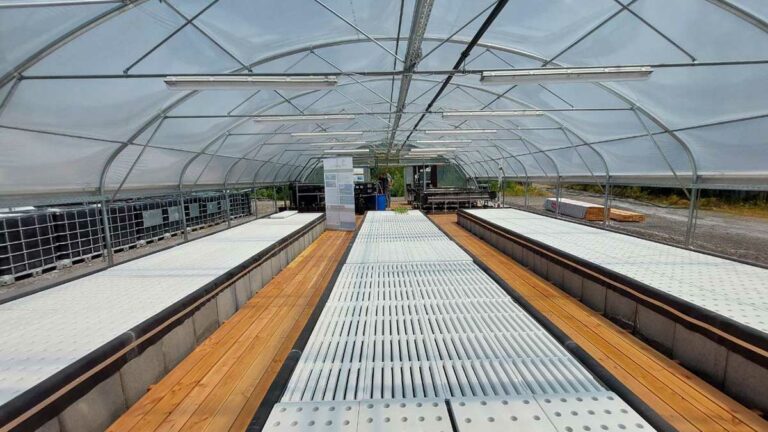
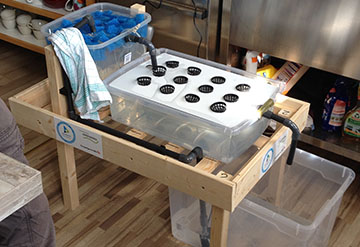
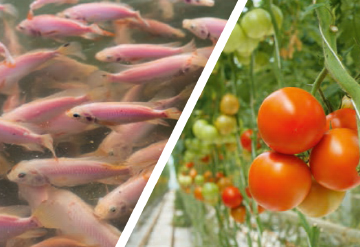
Aquaponics combines aquaculture and plant production in a coupled system. Fish are fed and grow. Their excretions enter the water. Microorganisms convert these substances into nutrients available to plants. The plants take up the nutrients. The purified water is returned to the aquaculture system [2].
What is a burden or waste in a linear system becomes the basis for new production within the cycle.
Aquaponics thus makes visible nutrient flows that often remain hidden in other systems. The nitrogen cycle is no longer an abstract biological process, but becomes a technical and operational reality: feed becomes fish growth, fish metabolism becomes plant nutrient, plant nutrient becomes vegetables, herbs or lettuce.
Those who understand material flows begin to think differently about agriculture. It is no longer only about individual products, but about relationships: between water and nutrients, between fish and plants, between microorganisms and yield, between input and output.
Aquaponics as a starting point for coupled cycles
Aquaponics initially describes the cycle between fish, bacteria and plants. But it does not end there. It becomes a revolving door to further cycles.
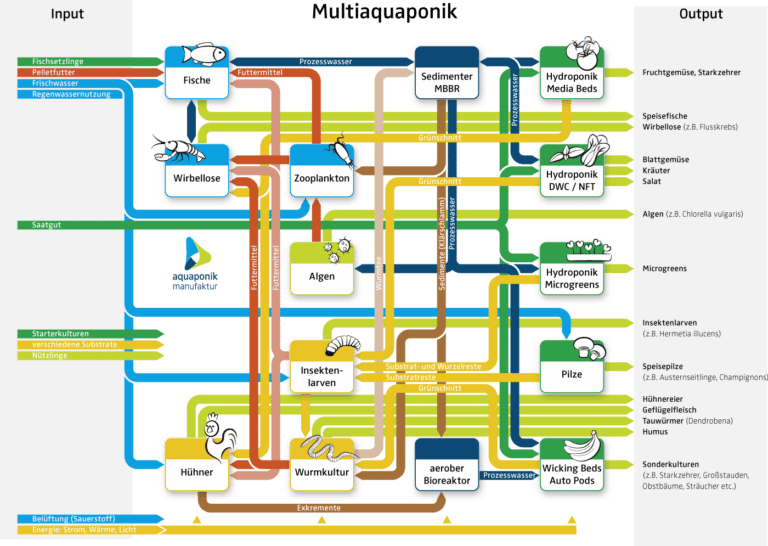
Plant residues can serve as input for additional biological processes. Insect larvae can utilise organic residues and turn them into protein-rich biomass. This biomass can in turn be integrated into feed streams. Poultry can become part of adjacent material flows. Chicken manure can enter biogas processes or, after appropriate treatment, once again be considered a nutrient source. Rainwater can reduce water demand. Waste heat from a biogas combined heat and power plant can temper aquaculture and plant production and provide the electricity required.
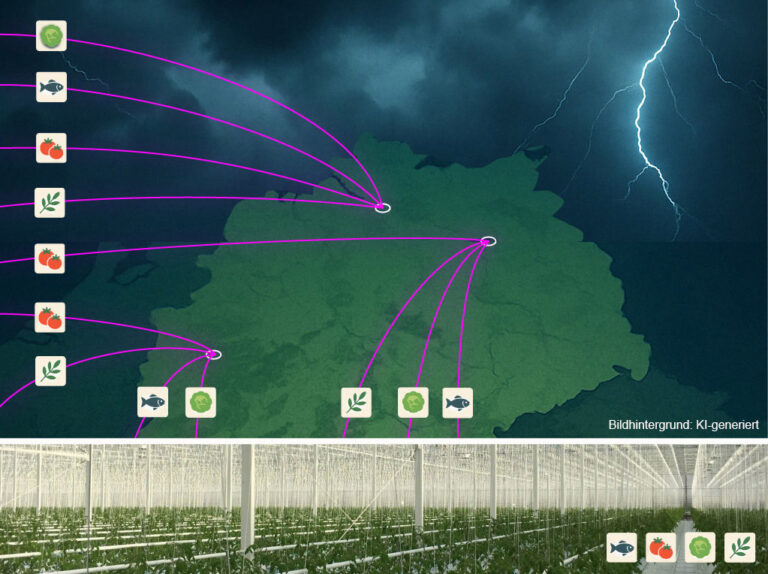
The cycles shown in the illustration are not a pure vision of the future. Many of these material-flow connections already exist today in research, practice or neighbouring agricultural systems. What matters is not that every system contains all modules. What matters is which resource flows can be meaningfully connected on site.
Aquaponics creates a productive core cycle. From there, further modules can be connected: insect larvae, poultry, biogas, fungi, composting, vermiculture or other forms of biological utilisation. A production system becomes a circular architecture.
From raw materials to resource flows
The more consistently cycles are considered, the more unnecessary the terms “waste” and “raw material” become, because plant residues contain biomass. Fish excretions are no longer a burden, but nutrient carriers. Heat is not waste heat. It is a usable energy flow. Rainwater is a resource and organic residues are not a disposal problem, but potential inputs. What remains are resource flows moving through the system in different forms.
This is the actual meaning of biological circular economy. It designs the system in such a way that materials remain usable.
Circular economy means resilience
Every locally closed cycle reduces dependencies. When nutrients are kept within the system, the need for external inputs decreases. When water is used multiple times, production becomes less dependent on dry periods. When waste heat is used meaningfully, new value creation potential emerges. When organic residues are further utilised, additional production pathways arise.
Circular economy is not only an ecological idea. It is also a strategy for more robust farms, regional value creation and reduced dependence on complex supply chains.
This applies in particular to agricultural businesses looking for new sources of income, better use of existing infrastructure or more intelligent ways to connect heat, biomass, water and nutrients.
From aquaponics to the productive biotope
Aquaponics is not the only form of biological circular economy. But it is a particularly vivid starting point.
It shows how closely production, metabolism and system design are connected. It makes visible that circular economy does not begin at the recycling centre, but wherever nutrients, water, energy and biomass are kept within the system.
The next step leads from aquaponics to multiaquaponics and further towards the productive biotope: systems in which different organisms, production areas and material flows are connected. We have already described such a productive biotope with 12 modules here [3].
The question, therefore, is not whether biological circular economy is possible.
The question is how consistently we want to use it.
The future of circular economy lies not only in the recycling of materials, but also in the intelligent use of biological cycles. Aquaponics shows how water, nutrients, biomass and energy can be connected to form productive resource flows — not as a contradiction to agriculture, but as a further development of its oldest strength.
Sources:
[1.] Action programme for the implementation of the National Circular Economy Strategy https://www.bundesregierung.de/breg-de/aktuelles/kabinett-kreislaufwirtschaft-2436106
[2.] Basics of aquaponics
[3.] Multiaquaponics and productive biotope