
In Germany, around 50 hectares of land are currently being newly used every day for settlement and transport purposes [1]. Many of these areas are often no longer available for agriculture in their previous form. For farms that cannot simply expand indefinitely, the question of creating new value on smaller areas is becoming increasingly important.
How can the remaining land be used more intensively? What role can existing buildings, heat, water and regional sales channels play? And when is it worth looking at production systems that do not depend on many hectares of arable land? This is precisely where Aquaponics comes in.
When land is no longer enough
Even if a farm wants to grow, the land does not grow with it. Leased land is scarce, purchase prices are high, and where agricultural land is converted into residential areas, commercial areas, roads or compensation areas, the land available for agricultural use becomes smaller.
It becomes particularly difficult when a farm continues to exist, but the available land is no longer sufficient for conventional arable farming. Then the question is no longer only how many hectares can be cultivated, but how the existing farmstead can remain economically viable.
Can the farm be used more productively? Are there buildings, heat sources, water, paved areas, regional sales channels or existing customer relationships that could be used for a new branch of business? And can this become a form of agriculture that requires less land but creates more value per square metre?
From hectares to value per square metre
Conventional arable farming thinks in hectares. That makes sense as long as enough land is available. But when land becomes scarce, the question changes: what kind of value creation is possible on the land that remains?
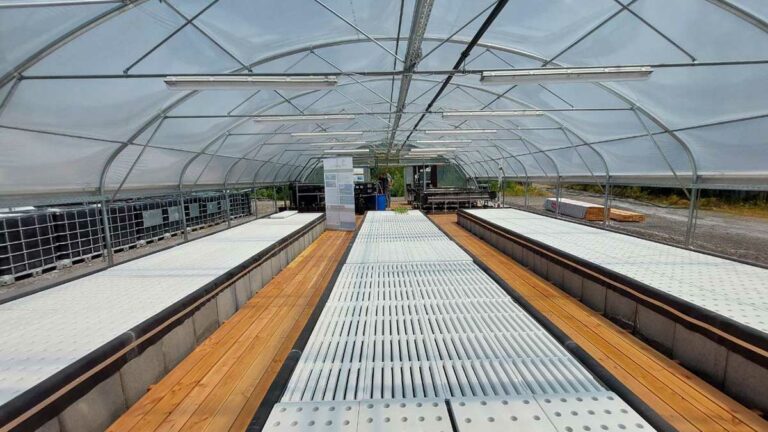
For small farms, part-time farms or farm successors, this change in perspective can be decisive. An area that is not attractive for conventional arable farming can take on a completely different meaning as greenhouse space, with protected cultivation and coupled production. This can also include side areas that have so far only been mown.
Why existing buildings can be interesting
Many farms have buildings that are no longer optimally used for their original purpose: old stables, halls, storage areas or paved farmyards. Such existing structures can become a starting point for new utilisation concepts.
However, caution is needed. Not every building is automatically suitable for aquaponics or protected cultivation. That is precisely why the first step should not be the construction of a system, but a professional assessment of the possibilities.
Calculate your own scenarios
Every location is different. Buildings, heat, water, working time, investment framework and marketing all determine whether an aquaponic concept can make economic sense.
With our aquaponics calculator, you can calculate initial scenarios and develop a first feeling for dimensions, production volumes, investments and operating costs.
Would you like to calculate your own scenarios?
Then feel free to use our aquaponics calculator.
Conclusion
When farmland becomes commercial land, or when a farm has become too small for conventional arable farming, this does not automatically mean the end of agricultural use. But it does mean that different questions have to be asked.
How can existing land be used more productively? What role do buildings, heat, water and regional sales channels play? And which production systems can create new value on a smaller area?
Aquaponics is not a simple standard solution. But for certain farms, it can be an option worth examining — especially when farmsteads, small areas and existing infrastructure are to be used in a new way.
The first step is a realistic assessment.
Contact us by email: info@aquaponik-manufaktur.de
Source
[1] German Environment Agency / Destatis, settlement and transport area 2021–2024
https://www.umweltbundesamt.de/indikator-siedlungs-verkehrsflaeche