
How APM strengthens your circulatory research from application to implementation.
The circular economy is the necessary goal of our economic transformation. But for this change to succeed, we urgently need evidence-based decision-making tools.
It is no longer enough to simply model cycles – we must prove that they function technically, economically, and socially. Applied research has a responsibility here to bridge the gap between theory and practice. To not only demand but effectively promote genuine progress, we need valid data from real-world operations.
But this is precisely where many universities and institutes face a challenge: They conduct excellent research on specific aspects such as resource efficiency or water quality, but the systemic context is often lacking in the traditional laboratory. Controlled Environment Agriculture (CEA) does provide precise climate data, but rarely depicts a closed biological cycle.
Here we close the gap.
Aquaponics as a systemic living laboratory
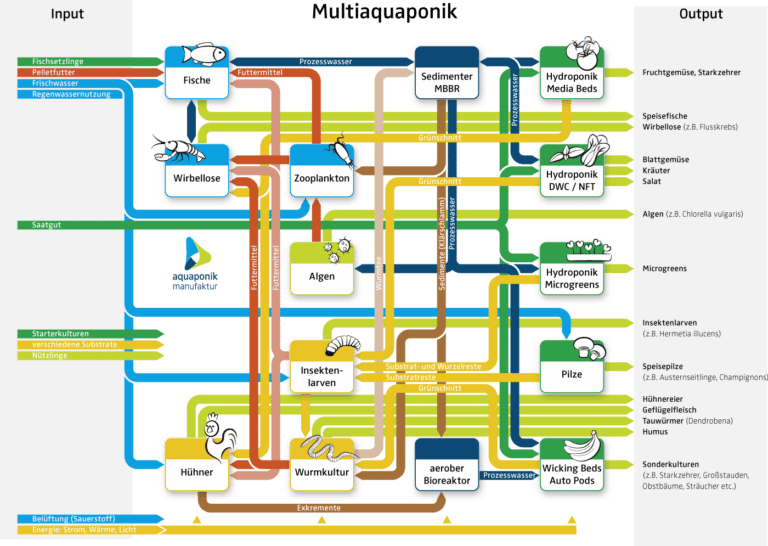
Aquaponics is more than just fish and salad. From a systems theory perspective, it is one of the few available models that offers a complete, coupled nutrient cycle represented on a controllable scale. Fish, plants, microbiology and water form a coupled ecosystem in which nutrients do not disappear (disposal), but rather exchange roles (valuation).
What was long considered a niche topic is now moving into the core area of applied sustainability research. Aquaponics systems serve as ideal Living Labs,to answer the pressing questions of Planetary Boundaries. How do we decouple food production from land use? How do we achieve true nitrate neutrality?
The role of APM: More than just plant engineers
For aquaponics to be more than just a demonstration in science, it needs professional infrastructure and reliable data. Aquaponics Manufactory (APM) sees itself not only as a supplier, but as a strategic enabler for your research. We offer collaboration on two levels:
1. The hardware: Validated research infrastructure
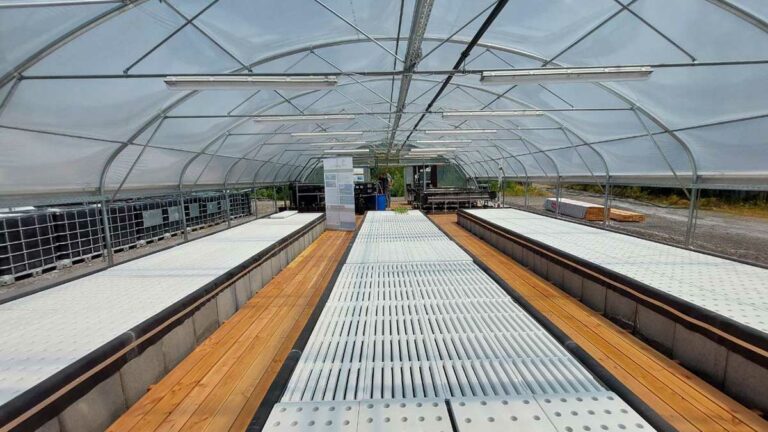
We develop and build systems specifically tailored to scientific requirements. We don't deliver "DIY solutions," but scalable technology.
- From module to large scale project: Whether a compact test module for the campus or an industrial pilot plant in a greenhouse – our systems are scalable.
- Data excellence Our systems are designed for data acquisition. Defined measuring points and interfaces enable the setup of digital twinsYou will receive valid long-term data on material flows and energy balances as a basis for high-impact publications.
- Experimental reliability: Through standardized processes, we minimize the risk of system failures so that your test series are not jeopardized.
2. The partner: Support within the consortium & application
We know how complex modern funding applications (Horizon Europe, BMBF, Green Deal) can be. As an experienced SME partner, we specifically strengthen the impact section of your application:
-
Impact Pathways: We provide the lines of reasoning for paths such as biodiversity protection (area relief), Zero Pollution (wastewater-free technology) and Food Security.
-
TRL-Lift We help you transfer theoretical models into physical real-world laboratories, thereby raising the Technology Readiness Level (TRL) of your research.
-
Dissemination & Exploitation: We'll take care of the Capacity BuildingWe transfer your research results directly into training formats for vocational education and industrial users. This ensures the required "social impact".
Measurable Impact: Metrics & Policy Alignment
The research of the coming years will require quantifiable contributions. With the APM System-Framework we deliver exactly the key figures that expert panels want to see nowadays.
The 5 efficiency colums (Efficiency Metrics)
- Water Use Efficiency (WUE): Maximizing biomass production per liter of water. By closing the loop, we achieve savings of >95% compared to conventional farming.
- Land Use Efficiency (LUE): Decoupling production from the land. Through vertical stratification and the use of sealed surfaces (roofs, industrial brownfields), we free up arable land for biodiversity measures.
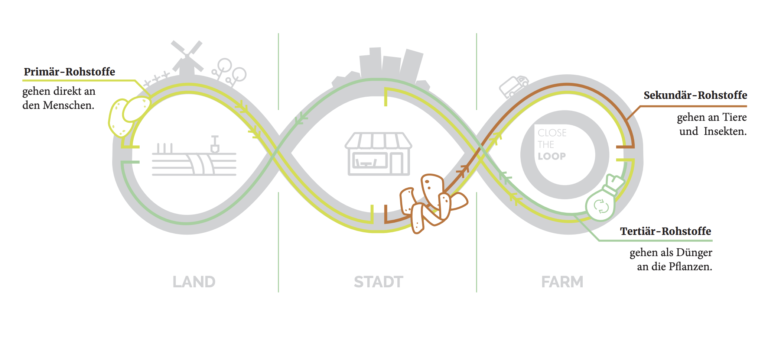
- Nutrient Use Efficiency (NUE): Transformation of waste into valuable material. We almost completely close the N-P-K cycle, recover critical raw materials such as phosphorus, and prevent nutrient runoff (eutrophication).
- Energy Use Efficiency (EUE): Sector coupling as standard. We integrate industrial waste heat and renewable energies to minimize the CO2 footprint per calorie.
- Social Return on Investment (SROI): Value creation beyond the balance sheet. Our projects create local resilience, educational opportunities, and qualified "green jobs" in urban areas.
Strategic “docking stations”
We ensure that your research project is politically viable. Our infrastructure directly addresses the goals of key frameworks:
-
EU Farm to Fork strategy: We provide the technological answer to the required reduction of pesticides (-50% target vs. -100% reality) and nutrient losses.
-
National Water Strategy: Our “Zero-Discharge” technology meets the requirement for prioritizing water use and protecting groundwater.
-
EU Taxonomy & Circular Economy: We meet the “Substantial Contribution” criteria for the circular economy, which increases our attractiveness for follow-up financing.
In conclusion: We build the tools to answer your questions
Whether you want to research poly cultures , analyse food quality under defined stress scenarios or simulate system stability We provide the technological basis.
Let's talk about how we can strengthen your next research project – whether as a supplier of your infrastructure or as a partner in your consortium.
Next step: The exploratory talks
Are you currently planning an application or looking for suitable infrastructure for your institution?
We invite you to a free, no-obligation 30-minute introductory meeting. We will briefly analyze your research objectives and outline which contribution APM (hardware, data, or partnership) offers the greatest leverage for your success.
We can be reached at the following telephone number: (+49) 02835 9819463.
Contact us by email: info@aquaponik-manufaktur.de